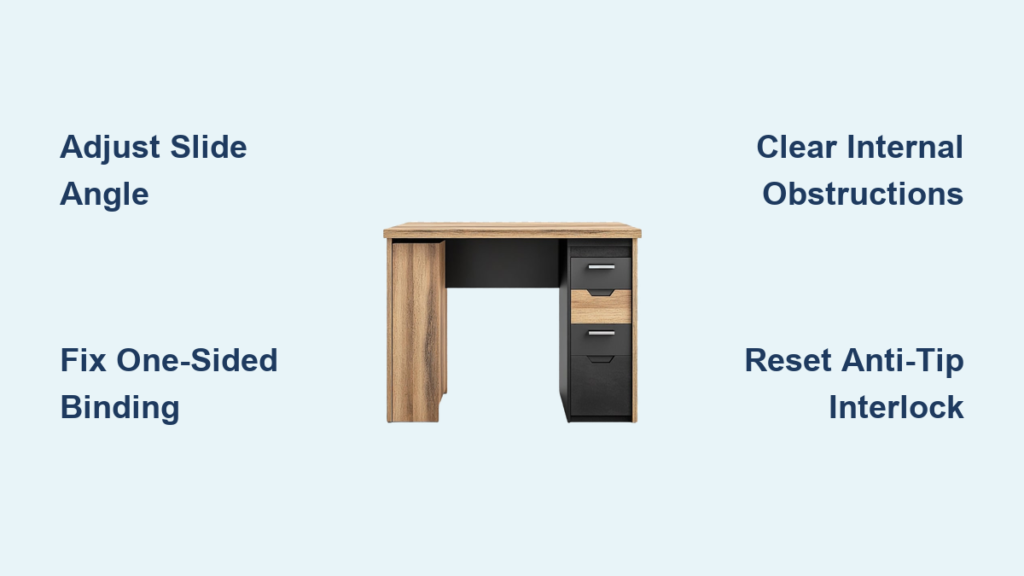
If your desk drawer won’t close, you know how frustrating this common office furniture problem can be. Whether the drawer creeps open on its own, sticks halfway, or hits a hard stop before sealing, the issue disrupts your workspace and wastes your time. The good news? Most causes are fixable in under 30 minutes with basic tools you already own.
This guide walks you through every proven fix, from adjusting slide angles to clearing hidden obstructions. You’ll learn why a drawer might self-open, how to fix one-sided binding, and when it’s time to upgrade your hardware. By the end, you’ll have a drawer that glides smoothly and stays closed every time.
Diagnose the Problem Before Repairs
Jumping straight to repairs without identifying the cause can make things worse. Use these quick checks to pinpoint what’s really stopping your drawer from closing.
Check for Self-Opening or Creeping
If the drawer slowly slides open after being closed, gravity is pulling it forward. This happens when the slides angle downward toward the front. Try this test: close the drawer, then gently press down on the front. If it stays shut, the slide angle is likely the culprit.
Test for One-Sided Binding
When one side of the drawer sticks or requires lifting to close, lateral misalignment is usually to blame. Pull the drawer out slowly and watch both sides. Does one roller catch or rise out of the track? If so, that side’s slide is either too high or too low at the back.
Look for Hard Stops Near Full Closure
A sudden stop near full closure means mechanical interference. The drawer back may be hitting a stop block, or the front is rubbing against an adjacent drawer. Open the drawer fully and inspect the rear interior with a flashlight. Is there contact between the drawer and a fixed wooden block?
Rule Out Internal Obstructions
Items inside the drawer can press against the top or sides, preventing closure. Try closing the drawer with upward pressure. If it shuts, something inside is likely pushing up. Common culprits include standing folders, picture frames, or thick notebooks.
Verify Anti-Tip Interlock Engagement
In multi-drawer desks or lateral files, only one drawer can be open at a time. If another drawer is partially open, the interlock bar may block closure. Fully open and close a different drawer to reset the mechanism.
Fix Slide Angle to Stop Self-Opening

A drawer that creeps open is almost always due to a downward front-to-back slide angle. Fixing it takes about 5 minutes and one simple adjustment.
Raise the Front of the Slide
Remove the drawer by pulling it fully out, then press the plastic release tabs or lift upward to disengage. Locate the front screw on each slide, usually one per side. Loosen the back screws slightly, then lift the front of the slide upward by 1/16 inch. Retighten the back screw while holding the angle to lock the front in a slightly raised position.
This works because raising the front creates a positive cam effect. When closed, the drawer naturally wants to move forward, keeping it shut.
Use Longer Screws for Stability
Original screws are often too short to grip solid wood. Replace them with 1- to 1.5-inch heavy-duty screws. Drill a new pilot hole just above the original front screw hole, then insert the longer screw to anchor deeply into the frame. Repeat on the opposite side for symmetry.
Alternative: Lower the Rear of the Slide
If raising the front isn’t possible, lower the back instead. Loosen the back screws and gently tap the slide downward. This achieves the same net angle correction.
Correct Lateral Misalignment

When one side binds or rubs, the slides aren’t level with each other. Even a 1/16-inch difference can cause binding.
Identify the High Side
If the left side binds, either the left slide is too high at the back, or the right slide is too low at the back. Test by closing with downward pressure on each side. If pressing the left side allows closure, the left slide is likely too high.
Adjust Slide Height
Loosen the screws on the affected side. Slightly raise or lower the back of the slide. Re-tighten while checking for smooth movement.
Use a Spacer Block for Consistency
Cut a scrap wood block to the exact height you need. Place it under the slide at the mounting point, and use the same block on both sides to ensure identical alignment. Measure from the bottom of the cabinet case to the bottom of each slide to ensure both are at the same reference point.
Clear Internal Obstructions
You’d be surprised how often a drawer won’t close because of what’s inside, not the hardware.
Depress Stuck Items Through the Gap
Use a butter knife to slide between the drawer contents and the desk frame. Try a long-handled spatula or flexible ruler to push down folders or books. Insert cardboard to hold items down while closing.
Shake the Drawer Free
If the drawer is full of small items like pens, notepads, or clips, shake it side-to-side or front-to-back. This often repositions loose contents blocking closure. Users report shaking almost always works, especially with drawers full of little things.
Reach from Below
Remove the drawer beneath and access the jammed drawer from underneath. Use a coat hanger with a bent tip to hook and pull stuck items forward.
Trim Drawer Fronts for Clearance
If drawer fronts rub against each other or the frame, minor sanding or planing can fix it.
Mark the Interference Point
Close the drawer slowly and watch where it rubs. Apply masking tape to the contact area and mark with a pencil.
Remove Material Gradually
Use a belt sander for aggressive shaping, following the line carefully. An electric planer works best for flat surfaces; test on scrap first. Hand sanding with a block is ideal for final smoothing.
Take 1/32-inch passes and test-fit frequently. Over-trimming ruins the look and is difficult to fix.
Modify Stop Blocks or Drawer Backs
A hard stop at the rear usually means the drawer is hitting a wooden stop block.
Trim the Stop Block
Use a chisel, sander, or file to shave down the block. Remove 1/16 inch at a time and test closure. You can also notch the block to create clearance for the drawer back, which is safer than trimming the drawer itself.
Trim the Drawer Back Only If Necessary
If the block can’t be modified, lightly sand the top edge of the drawer back. Avoid removing too much, as this weakens the drawer structure.
Fix Anti-Tip and Interlock Issues
Common in lateral file cabinets, these mechanisms prevent tipping by allowing only one drawer open at a time.
Reset the Interlock
Fully open and close another drawer. This often resets the metal bar at the rear. You can also tilt the cabinet slightly to free a stuck interlock, which has reported success in older models.
Inspect the Interlock Bar
Remove the bottom drawer and shine a flashlight into the back. Look for an 18-inch by 2-inch metal bar and ensure it moves freely. Lubricate with PTFE or silicone spray if sticky.
Adjust Locking Tabs
Use pliers to gently bend misaligned tabs on the inner rail. If damaged, replace the glide assembly. Many brands allow replacement without exact measurements if the metal rail is intact.
Realign Ball-Bearing Slides
Sometimes slides come partially disengaged, especially after overextension.
Reinsert the Drawer into the Track
Pull the drawer fully out, then lift upward to disengage the rollers. Align the rollers with the track and slowly push in while keeping it level.
Use Lift-and-Push Technique
While closing, lift the drawer slightly. This helps the rollers reseat properly and works especially well on older ball-bearing glides.
Replace Damaged Glides
If slides are cracked, bent, or rollers are broken, replacement is the best fix.
Upgrade to Better Hardware
Install full-extension ball-bearing or soft-close undermount slides. These are more durable than basic plastic glides, offer smoother operation, and include a self-closing feature. Easy to install with proper alignment.
Ensure Proper Installation
Mount new slides level and square. Use spacer blocks to match height on both sides. Confirm equal depth front-to-back.
Try Temporary Fixes
Need a quick hold until you can fix it properly? These temporary solutions work in a pinch.
Add Magnetic Closure
Glue small neodymium magnets to the cabinet interior and back of the drawer. Use super glue for strong adhesion. This provides gentle pull to keep the drawer closed. Best for light drawers, not ideal for heavy loads.
Use Adhesive Bumpers
Stick rubber bumpers inside the cabinet to create friction. Or use sticky magnets as quick hold-backs. These aren’t permanent fixes but work quickly.
Prevent Future Issues
Stop the problem before it starts with these simple habits.
Level the Desk First
Check the floor and desk with a torpedo level. If the desk leans forward, add ¼-inch spacers under front feet. On carpet, ensure tack strips aren’t pushing the back of the desk.
Test Fit Before Finishing
Always test the drawer’s movement before applying final finish or installing hardware. It’s much easier to adjust now than after finishing.
Maintain Every 3 to 6 Months
Clean tracks with a dry cloth. Lubricate with silicone spray, never oil. Tighten loose screws and inspect for wear or warping. When maintenance fails, replace with high-quality slides to extend your desk’s life.
When to Upgrade Hardware
If your desk has plastic glides or basic side-mount slides, consider upgrading.
Recommended Upgrades
Soft-close undermount slides are hidden, smooth, and self-closing. Full-extension ball-bearing glides let you access the entire drawer. Euro-style roller-on-rail is low profile but requires precise alignment.
A $20 upgrade can turn a frustrating desk into a joy to use.
Frequently Asked Questions About Desk Drawer Won’t Close
Why does my desk drawer keep opening on its own?
This happens because the slides angle downward toward the front, letting gravity pull the drawer open. Fix it by raising the front of each slide slightly or lowering the rear to create a positive forward angle.
How do I fix a drawer that sticks on one side?
One-sided binding means the slides aren’t level. Determine which side is high by pressing down on each side while closing. Adjust the high side by loosening its back screws and lowering it slightly. Use a spacer block to ensure both sides match.
Can items inside the drawer prevent it from closing?
Yes. Standing folders, thick notebooks, or picture frames can press against the top or sides. Try closing with upward pressure to confirm. Use a butter knife or spatula to push items down, or shake the drawer to reposition loose contents.
What if the drawer hits something at the back?
The drawer back is likely hitting a stop block. Open fully and inspect with a flashlight. Trim the stop block with a chisel or sandpaper in small increments. Alternatively, notch the block for clearance.
How do I reset an anti-tip interlock?
Fully open and close another drawer to reset the mechanism. If that doesn’t work, tilt the cabinet slightly to free a stuck interlock bar. Remove the bottom drawer and lubricate the interlock with silicone spray if it’s sticky.
When should I replace the drawer slides?
Replace slides if they are cracked, bent, or have broken rollers. Upgrading to ball-bearing or soft-close slides resolves persistent problems and provides smoother operation. It’s worth the investment for frequently used desks.
Key Takeaways for Fixing Your Desk Drawer
Most desk drawer issues come down to three main causes: slide angle problems, obstructions, or leveling issues. Start with the simplest fix. Try shaking the drawer, resetting the interlock, or lifting while closing. If that fails, adjust the slide angle or check for binding on one side.
The most common fix is raising the front of the slide to create a positive cam effect that keeps the drawer closed. Use longer screws for permanent stability. For recurring problems, upgrade to quality ball-bearing or soft-close slides.
With the right approach, you can fix a stubborn drawer in under an hour and keep it working smoothly for years. Regular maintenance every few months prevents future issues and extends the life of your furniture.