You sit down to work, and within an hour, your shoulders ache, your wrists tingle, or your back starts to throb. The culprit? Your desk height. The question how high should a desk be is more critical than most realize. A poorly positioned desk disrupts posture, strains muscles, and can lead to long-term health issues. Yet, most standard desks are built for one height: around 29 inches, ideal only for someone close to 6 feet tall. For the majority of people, especially those under 5’10”, this one-size-fits-all approach fails.
The truth is, the ideal desk height is not universal. It is personal. It depends on your height, chair, footwear, and even how you type. Whether you are using a sitting desk, a standing desk, or switching between both, the core principle remains: your desk should align with your elbow height when your arms are bent at 90 to 110 degrees. This simple rule prevents shoulder elevation, keeps wrists neutral, and supports long-term comfort. In this guide, you will learn how to calculate your perfect desk height, spot common setup mistakes, and adapt any desk for optimal ergonomics.
Standard Desk Height Explained
Why 29 Inches Is Not Right for Most
The standard desk height across most commercially available office and home desks is 28 to 30 inches, with 29 inches (73.5 cm) being the most common. This height was designed decades ago based on average male stature and has remained unchanged despite shifting demographics and ergonomic research. While it works well for people around 6 feet (183 cm) tall, it is too high for about 70% of the population, especially women and shorter individuals.
Most office chairs can only lower to about 16 to 18 inches, meaning users under 5’8″ often cannot position their elbows level with a 29-inch desk without letting their feet dangle. This leads to poor posture, reduced circulation, and increased lower back strain. Even adjustable desks often start at 28 inches, still too high for ergonomic sitting for many. The result is widespread discomfort, with users reporting shoulder pain, wrist fatigue, and chronic back issues from day one.
Standing Desk Height Range
Unlike sitting desks, there is no single standard for standing desks. Most height-adjustable models range from 35 to 47 inches, with fixed standing desks typically set at 38 to 42 inches. These ranges aim to serve users between 5’4″ and 6’2″, but shorter users often find even the lowest settings too high. The key is adjustability: a true sit-stand desk should go as low as 22 inches and as high as 50 inches to accommodate users from 5’0″ to 6’6″.
Find Your Ideal Desk Height
Match Desk to Elbow Height
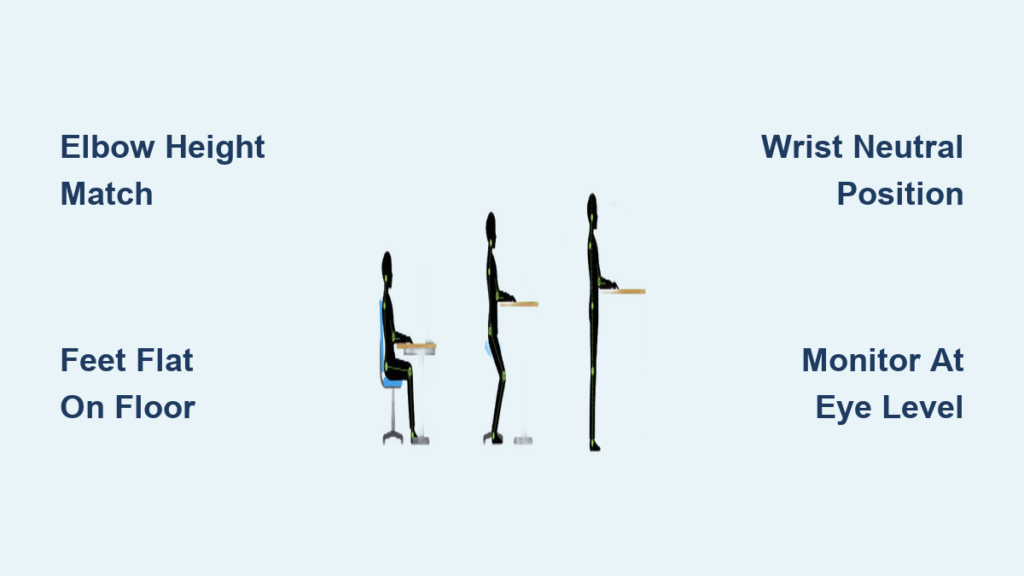
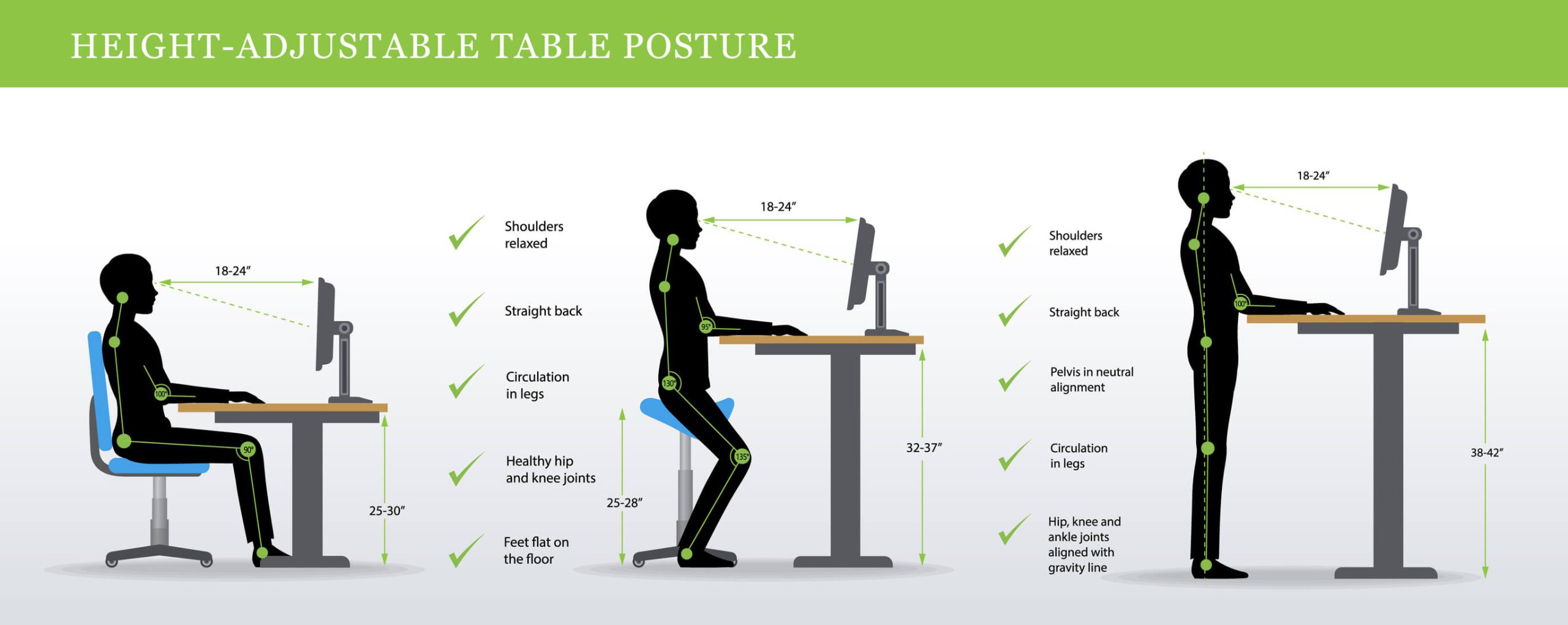
The golden rule of ergonomic desk setup is simple: your desk height should match your elbow height when seated or standing with arms bent at 90 to 110 degrees. This ensures your shoulders stay relaxed, your forearms lie flat, and your wrists remain neutral, critical for preventing carpal tunnel and shoulder strain.
To check your ideal desk height:
- Sit or stand in your usual working posture
- Bend your elbows to 90 degrees
- Measure from the floor to the bottom of your elbow (humeroradial joint)
- That number is your ideal desk height
For example, if you are 5’7″ and your elbow measures 26 inches from the floor, your desk should be 26 inches high, not the standard 29″. This small difference can eliminate years of preventable discomfort.
Use Height-Based Formulas
If you do not have a tape measure, use these formulas to estimate your ideal desk height based on your total height including shoes.
Sitting Desk Height (in inches):
- Quick Estimate: Height (in) divided by 2, minus 8.5 (minimum) to Height (in) divided by 2, minus 6 (maximum)
- More Accurate (Linear Regression): Minimum equals 0.4739 times height minus 6.678, Maximum equals 0.5538 times height minus 9.427
Example: For a 5’7″ (67″) person:
Minimum: 0.4739 × 67 minus 6.678 equals approximately 25″
Maximum: 0.5538 × 67 minus 9.427 equals approximately 27.5″
Ideal sitting desk: 25 to 27.5 inches
Standing Desk Height:
- Formula: 0.54 times height plus 5 to 0.58 times height plus 6
- Simpler: Standing desk should be within 1 to 2 inches of elbow height
For 5’7″: 0.54 × 67 plus 5 equals approximately 40.5″ to 0.58 × 67 plus 6 equals approximately 44.9″
Ideal standing desk: 40.5 to 44.9 inches
Recommended Desk Heights by Height
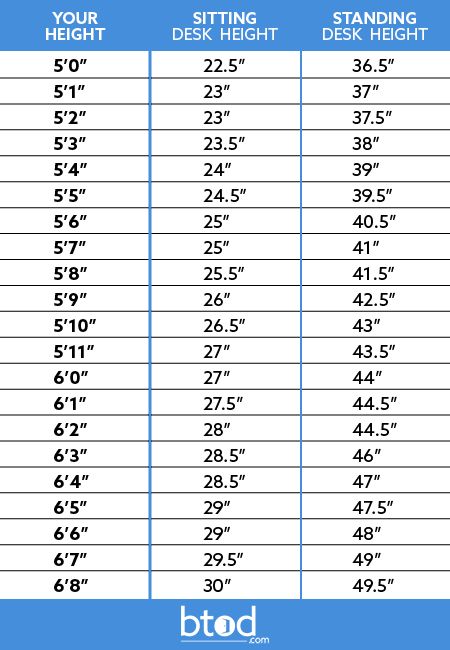
Sitting Desk Height Chart
| Your Height | Ideal Desk Height (in) | Ideal Desk Height (cm) |
|---|---|---|
| 5’0″ | 22.5–24.5 | 57–62 |
| 5’2″ | 23.5–25.5 | 60–65 |
| 5’4″ | 24–26 | 61–66 |
| 5’5″ | 24–26.5 | 61–67 |
| 5’6″ | 24.5–27 | 62–69 |
| 5’7″ | 25–27.5 | 63.5–70 |
| 5’8″ | 25.5–28 | 65–71 |
| 5’9″ | 26–28.5 | 66–72 |
| 5’10” | 26.5–29 | 67–74 |
| 6’0″ | 27.5–30 | 70–76 |
Always measure with shoes on. Heels or thick soles can add up to 2 inches.
Standing Desk Height Chart
| Your Height | Ideal Standing Desk (in) | Ideal Standing Desk (cm) |
|---|---|---|
| 5’0″ | 36–38 | 91–97 |
| 5’2″ | 37–39 | 94–99 |
| 5’4″ | 38–40 | 97–102 |
| 5’5″ | 38.5–40.5 | 98–103 |
| 5’6″ | 39–41 | 99–104 |
| 5’7″ | 40.5–43.5 | 103–110 |
| 5’8″ | 41–44 | 104–112 |
| 5’9″ | 41.5–44.5 | 105–113 |
| 5’10” | 42–45 | 107–114 |
| 6’0″ | 43.5–46.5 | 110–118 |
Pro Tip: If your standing desk does not go low enough, consider an anti-fatigue mat and slight forward lean to reduce arm elevation.
Fix Your Chair and Posture
Set Chair Height Correctly
Your chair height directly affects how well your desk works. Follow these rules:
- Thighs should be parallel to the floor
- Lower legs should form a 90 to 110 degree angle with thighs
- Feet should be flat on the floor or on a footrest
Most office chairs adjust between 16 and 20 inches. If your chair is at its lowest and your feet dangle, your desk is likely too high. A footrest is not a luxury, it is essential for proper ergonomics. Without foot support, you lose pelvic stability, increasing pressure on your lower back.
Align Elbows and Wrists
Once seated:
- Rest hands on the keyboard
- Elbows should be at 90 to 110 degrees, hanging loosely at your sides
- Wrists should be straight and neutral, not bent up, down, or sideways
If your shoulders are hunched or arms are elevated, your desk is too high. If your wrists bend downward, the desk may be too low. Pain-free typing for 2 to 4 hours is the best test of a correct setup.
Optimize Monitor and Equipment
Position Monitor at Eye Level
Your desk height affects monitor placement, but the two are independent. Follow these rules:
- Top third of the screen should be at or slightly below eye level
- Screen should be 20 to 30 inches away (about an arm’s length)
- Tilt monitor 10 to 20 degrees backward to reduce glare
For laptops, use a laptop stand and external keyboard and mouse. Otherwise, you will have to choose between bad posture and bad typing.
Account for Keyboard Thickness
Most keyboards add 1 to 1.5 inches of height. If you use a thick keyboard or wrist rest, you may need to lower your desk by 0.5 to 1.5 inches to keep wrists neutral. A keyboard tray mounted under the desk can help, especially on fixed-height desks.
Warning: Armrests that hit the desk surface force shoulder elevation. Either remove them or ensure your desk is low enough to allow clearance.
Adapt Any Desk for Ergonomics
Fix a Desk That Is Too High
If your desk is 29 to 30 inches but you are under 5’10”, here is how to adapt:
- Use a footrest to support feet and stabilize posture
- Install a keyboard tray to lower typing surface
- Switch to a low-profile keyboard (slim mechanical or membrane)
- Cut down desk legs (permanent but effective, use a saw and measure twice)
DIY Hack: Many users report success with plywood and 2x4s to build custom-height desks.
Raise a Desk That Is Too Low
If your desk is below 24 inches (a child’s desk or kitchen table):
- Add furniture risers (plastic, wood, or adjustable legs)
- Place books or plywood under legs as a temporary fix
- Use a monitor riser to correct screen height
- Sit on a firm cushion (not ideal, but better than craning your neck)
Choose the Right Desk Type

When to Get an Adjustable Desk
A height-adjustable desk is ideal if you:
- Switch between sitting and standing
- Share the workspace with others
- Are under 5’4″ or over 6’2″
- Have chronic back, neck, or wrist pain
- Work with growing children
Look for a desk with a 22 to 50 inch range, this covers nearly all adult users. Minimum adjustment range: 25 to 30 inches for sitting, 38 to 42 inches for standing.
Task-Based Height Tips
Desk height should also match your work:
- Typing: Desk at or slightly below elbow height
- Writing: Slightly above elbow height for natural pen angle
- Drawing/Precision Work: Above elbow height for better visibility
- Heavy Tasks (sawing): Below elbow height for stability
For computer work, lower is usually better as long as wrists stay neutral.
Avoid Common Setup Mistakes
Do Not Ignore Footwear
Your height with shoes matters. Boots, heels, or thick soles can add up to 2 inches. Always calculate desk height based on your typical work footwear, not bare feet.
Do Not Assume Ergonomic Means Adjustable
Many ergonomic desks are still fixed at 29 inches. True ergonomics means customization to your body, not just a label. Always check the height range before buying.
Do Not Overlook Armrests
Chair armrests that press into the desk force you to raise your shoulders. Either remove them, adjust them lower, or ensure your desk is low enough to allow clearance.
Final Checklist for Perfect Desk Height
- Elbows at 90 to 110 degrees when hands are on keyboard
- Wrists flat and neutral, not bent
- Feet flat or on a footrest
- Shoulders relaxed, not hunched
- Top of monitor at or below eye level
- Desk height matches elbow height (sitting or standing)
- Chair allows thighs to be parallel to floor
If all these are true, you have nailed it. If not, adjust one thing at a time, chair, desk, monitor, or accessories, until comfort lasts all day.
Frequently Asked Questions About Desk Height
What is the standard desk height and why does it not work for everyone?
The standard desk height is 28 to 30 inches, with 29 inches being most common. This height was designed for people around 6 feet tall and fails to accommodate the majority of users, especially those under 5’10” and shorter individuals.
How do I calculate my ideal desk height?
Measure from the floor to your elbow while seated with arms bent at 90 degrees. That measurement is your ideal desk height. Alternatively, use the formula: height in inches divided by 2, minus 8.5 to minus 6 for sitting desks.
Is 29 inches too high for a 5’6″ person?
Yes, 29 inches is typically too high for someone 5’6″. Most people at this height find 24.5 to 27 inches more comfortable. Using a footrest or keyboard tray can help compensate for desks that cannot be lowered.
What is the best desk height for standing desks?
Standing desk height should be approximately equal to your elbow height when standing with arms bent at 90 degrees. For most people, this falls between 36 and 46 inches depending on total height.
Should I get an adjustable desk if I share my workspace?
Yes, a height-adjustable desk is ideal for shared workspaces because it accommodates multiple users of different heights. Look for models with a range of 22 to 50 inches for maximum flexibility.
Does keyboard thickness affect desk height requirements?
Yes, standard keyboards add 1 to 1.5 inches of height. If you use a thick keyboard or wrist rest, you may need to lower your desk by 0.5 to 1.5 inches to maintain neutral wrist position.
Key Takeaways for Finding Your Perfect Desk Height
The standard 29-inch desk fails most people because it was designed for a narrow range of heights. The solution is not enduring pain, it is measuring, adjusting, and demanding better design. Your desk height should align with your elbow height when seated or standing, with arms bent at 90 to 110 degrees. This single principle prevents the shoulder elevation, wrist strain, and back pain that plague millions of workers daily.
Use the formulas and charts in this guide to calculate your ideal height, then test your setup with the goal of pain-free typing for several hours. Whether you buy an adjustable desk, modify your current furniture with keyboard trays and footrests, or build a custom solution, your desk should serve you, not the other way around. Take your height seriously, measure twice, and create a workspace that supports health, focus, and long-term comfort.