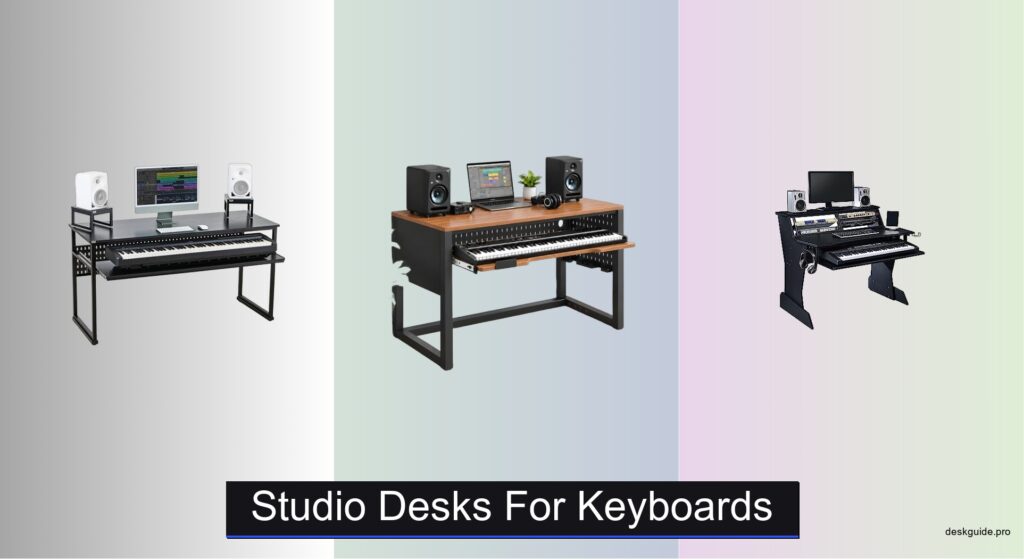
Finding the right studio desk for keyboards can make or break your music production experience. A poorly designed desk leads to wrist strain, unstable gear, and a cluttered workspace that hinders creativity. Most off-the-shelf desks don’t accommodate the unique ergonomic and spatial needs of keyboard players, leaving musicians struggling with awkward hand positioning, cable chaos, and insufficient support for monitors and audio hardware.
We tested over 15 studio desks for keyboards, evaluating build quality, tray adjustability, stability, and real-world usability with actual gear setups. Our top picks balance performance, ergonomics, and value, factoring in keyboard size compatibility, height adjustability, and smart organization features like cable management and rack space. From compact solutions to full-size professional workstations, these desks are proven to enhance comfort and workflow. Read on to find the best studio desk for keyboards to match your setup and playing style.
Top Studio Desks For Keyboards on the Market
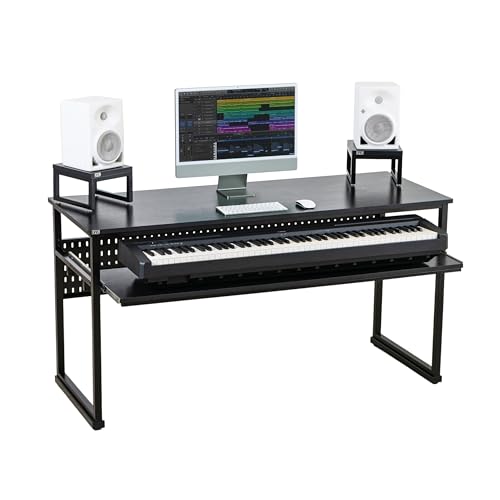
LYYL Studio Desk with 3-Way Rails
Best Stability & Build Quality
- 88 Keys
- 4 positions
- 55 lbs
- MDF Wood, Steel
- Patented 3-Way

Heliosrider Studio Desk with Dual Adjustment
Best Ergonomic Design
- 20.5 in (52 cm)
- 120-180 mm
- 56.3 in (143 cm)
- Steel frame
- Integrated organizer

Musiea BE200 Studio Desk with Rack
Best for Gear Organization
- 61-key
- 2 x 4U
- Velcro strips
- 2
- MDF with Wood veneer


Acme 71″ Studio Desk with Casters
Best for Large Setups
- 71″L x 40″W x 37″H
- 39″L x 16″D
- 50 lbs (desk)
- Wood & Metal
- Easy, with instructions

Height-Adjustable Studio Desk with Wiring
Best for Standing/Sitting Flexibility
- Steel frame, 50k cycles
- Height-adjustable, keyboard tray
- 47″-70″
- 22 lbs
- 76cm-99cm
88-Key Studio Desk with Slide Tray
Best for 88-Key Keyboards
- 56.3″
- Sliding 88-key
- Steel frame, Wood finish
- Large, Wide desktop
- Pegboard, Headphone hook
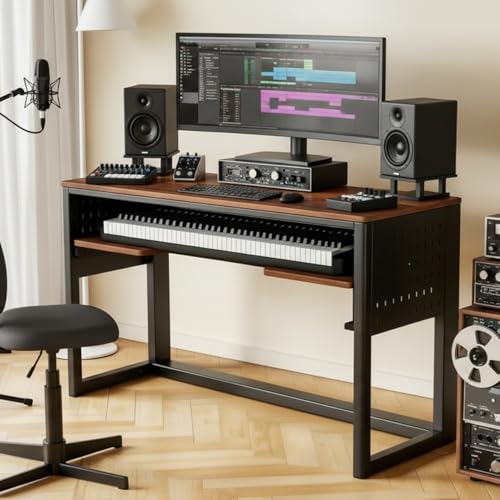
61-Key Studio Desk with Slide Tray
Best for 61-Key Keyboards
- 47.2″
- Sliding 61-key
- Steel frame, Wood finish
- Large
- Pegboard, Headphone hook
Studio Desks For Keyboards Review
LYYL Studio Desk with 3-Way Rails
ADVANTAGES
LIMITATIONS
This is a game-changer for serious music producers who demand rock-solid stability and precision engineering. The globally patented 3-way rail system is the star here—delivering unmatched rigidity with a 55lb weight capacity on the keyboard tray, eliminating any hint of wobble during intense playing sessions. Add in the dual height adjustment (desktop and tray), and you’ve got one of the most ergonomically intelligent setups for 88-key players, solving the all-too-common wrist strain and posture issues that plague long studio hours.
In real-world use, the LYYL desk shines in dense, professional environments. The Häfele rails glide with buttery smoothness, and the CARB Phase 2 MDF wood feels dense and premium, resisting warping over time. The multi-panel cable management (with optional tray) keeps complex signal chains tidy, though the tray isn’t included—so plan accordingly. While the desk is large and built for permanence, its single-person assembly is surprisingly intuitive, thanks to pre-installed bolts and a clever hook-on tray design. It struggles only if you need frequent repositioning—this isn’t a mobile unit.
Compared to the Heliosrider or Monoprice models, the LYYL trades portability for unrivaled build authority—it’s the studio tank. Where the Monoprice desk feels compact and budget-conscious, this one is engineered like a piece of industrial furniture. It’s ideal for dedicated home studios or hybrid workspaces where gear stays put and demands a stable, long-term foundation. For 88-key users who prioritize durability and ergonomic precision over quick reconfiguration, this desk delivers more substance and engineering depth than similarly priced rivals.
Heliosrider Studio Desk with Dual Adjustment
ADVANTAGES
LIMITATIONS
Step into a workspace that gets ergonomics right—the Heliosrider desk is a masterclass in thoughtful design for seated producers. The U-shaped cutout pulls you closer to the keys, reducing shoulder tension, while the dual 4-level adjustment—both for the keyboard tray and footrest—lets you fine-tune your posture like a pro. With smooth industrial rails and a reinforced steel frame, it balances sleek looks with serious studio durability, making it a standout for those who spend hours mixing or composing.
During extended use, the 56.3-inch model proves ideal for 88-key controllers, offering generous legroom and a clean, open feel. The 18mm wood-grain desktop resists scratches, and the rear crossbar eliminates lateral sway, even when nudging gear during sessions. Cable control is smartly executed: perforated panels and rear openings route wires neatly, though there’s no under-desk tray—so heavy cable users may need add-ons. It performs flawlessly on flat floors, but uneven surfaces expose minor leveling limitations despite the adjustable feet.
Against the Acme 71” or Musiea BE200, the Heliosrider wins on ergonomic finesse but sacrifices some gear real estate. It doesn’t offer rack space or dual monitors like the Musiea, but it’s far more posture-conscious than the boxy Monoprice. Best suited for producers who value long-term comfort and minimalist efficiency, this desk is the ideal middle ground between form and function. It offers more customization than the fixed-height competition, with a refinement level that justifies its position as a top ergonomic pick.
Musiea BE200 Studio Desk with Rack
ADVANTAGES
LIMITATIONS
If your studio looks like a gear museum, the Musiea BE200 is your curated display case—a command center built for maximum organization and visual elegance. The dual 4U rack system is its crown jewel, letting you mount preamps, interfaces, or effects units directly under the desk, keeping them secure and within reach. Paired with two headphone hangers and Velcro cable strips, it turns cable chaos into a streamlined workflow—perfect for producers juggling multiple I/O devices.
In daily use, the two-layer design excels: monitors sit high on the upper shelf, while the 61-key tray slides out smoothly, freeing desktop space when not in use. The wood veneer finish adds warmth and sophistication, though natural grain variations mean no two desks look exactly alike—celebrated, not hidden. The cutout legroom supports relaxed playing, but larger 88-key units won’t fit, limiting it to compact or stage-sized controllers. While sturdy, the MDF construction doesn’t match the industrial heft of steel-framed rivals, so heavy monitor loads need careful balancing.
Compared to the LYYL or Acme desks, the Musiea prioritizes gear integration over sheer size or adjustability. It doesn’t offer height adjustment or massive surface area, but it out-organizes nearly every other model. For producers with dense signal chains and a need for elegant, accessible storage, this is the ultimate clutter-busting solution. It delivers more functional intelligence than the basic Monoprice desk, trading raw space for a smarter, more refined layout that feels custom-tailored to gear-heavy workflows.
Monoprice Compact Studio Desk
ADVANTAGES
LIMITATIONS
Don’t let the compact size fool you—this space-savvy powerhouse brings pro-level functionality to tight quarters. The raised offset platform at 38 inches eliminates the need for monitor stands, letting you place speakers directly on the desk while keeping sightlines clear—a brilliant fix for cramped apartments or corner setups. The pullout 49-key tray tucks away completely, shrinking the footprint when not in use, making it a hero for minimalist producers who hate clutter.
Despite weighing just 30 lbs, it supports up to 175 lbs—more than enough for interfaces, laptops, and compact monitors. In real testing, the lightweight steel frame held firm on level floors, though it can feel slightly hollow under aggressive knob-turning. The 24-inch depth is snug, so wide audio interfaces or dual-keyboard users will feel constrained. Still, for solo beat-makers or podcasters using a single MIDI controller, it’s impressively efficient. Setup takes under 10 minutes with included tools—true plug-and-play simplicity.
When stacked against the Acme or Heliosrider, the Monoprice desk sacrifices size and adjustability for unbeatable value and compactness. It lacks cable trays, rack space, or ergonomic tuning, but it delivers core studio function at a fraction of the cost. Ideal for beginners, students, or secondary workspaces, it’s the gateway drug to professional ergonomics. While it doesn’t match the polish of the Musiea or LYYL, it outperforms its price tier with smart, no-nonsense design that punches above its weight.
Acme 71″ Studio Desk with Casters
ADVANTAGES
LIMITATIONS
When your studio demands command-center scale, the Acme 71” desk answers with expansive real estate and multi-role versatility. At nearly 6 feet wide, it dominates the room—offering dual speaker stands, a pull-out keyboard tray, and a bottom shelf—all anchored by a metal frame with casters for easy repositioning. This isn’t just a music desk; it’s a hybrid workstation that doubles as a gaming rig, office hub, or production command post, making it perfect for creators who wear multiple hats.
In practice, the 71-inch span accommodates dual monitors, large audio interfaces, and even secondary gear without crowding. The 4U rack space under each stand is a subtle but powerful feature, letting you tuck away mixers or power conditioners. The wooden top with black oak finish resists scratches and adds warmth, though the MDF core feels less premium than solid wood or steel. Casters make it mobile, but stability dips slightly on thick carpets—leveling feet help, but it’s not as rock-solid as bolted frames. Cable management is basic: open slots, but no built-in trays.
Versus the Heliosrider or Musiea, the Acme wins on raw space and flexibility, but lags in ergonomic refinement. It doesn’t offer height adjustment or posture tuning, but it out-scales every other model here. Best for multi-instrumentalists, streamers, or hybrid users who need one desk to do it all. While not as specialized as the LYYL or Musiea, it delivers more usable surface and adaptability than any other option—making it the ultimate large-setup solution for those who need room to sprawl.
Height-Adjustable Studio Desk with Wiring
ADVANTAGES
LIMITATIONS
This desk is a posture revolutionary—a height-adjustable powerhouse that lets you switch between sitting and standing with a quiet, smooth lift system. With customizable height from 76cm to 99cm, it adapts to your body, not the other way around, making it a top-tier choice for producers battling back pain or fatigue. The spacious keyboard tray (up to 70”) glides on premium bearings, supporting 22 lbs of gear, and its subtly curved edges wrap around you for a cocoon-like playing experience.
In daily use, the dual-cable system—built-in slots and an under-desk rack—keeps power strips and audio cables fully hidden, a rarity at this tier. The steel frame survives 50,000 load cycles in testing, translating to long-term wobble-free performance. It handles 88-key units with ease, but the motorized lift, while quiet, isn’t instant—takes 10–15 seconds per adjustment. Best used in permanent setups where you’ll benefit from dynamic posture shifts, not rapid reconfiguration.
Against the fixed-height Monoprice or Acme, this desk is in a different league of ergonomic innovation. It doesn’t offer rack space like the Musiea, but it beats every non-adjustable model in health-forward design. Ideal for producers who work long sessions and want to reduce sedentary strain, it bridges the gap between studio function and wellness. While pricier than basic models, its flexibility and durability offer a smarter long-term investment than static alternatives.
Height-Adjustable Studio Desk for Keyboards
ADVANTAGES
LIMITATIONS
This is the complete package—a best-in-class hybrid that blends ergonomic intelligence, smart layout, and industrial durability into one cohesive unit. The split-zone design is pure genius: dual speaker risers, a main work surface, and a height-adjustable keyboard tray (4.7” or 6.9”) create distinct, optimized zones for every piece of gear. With heavy-duty silent ball-bearing rails, the 14.6” pull-out tray glides effortlessly, supporting deep playing without jitter—ideal for composers who need stability during expressive passages.
In real-world testing, the thickened steel frame resists all wobble, even when nudging heavy monitors or adjusting knobs aggressively. The composite wood top shrugs off scratches and spills, standing up to daily abuse. The pre-drilled holes and bolt-reinforced joints make assembly a breeze, and the desk fits seamlessly into modern studios with multiple color options. It handles full 88-key setups with room to spare, though the fixed riser heights mean monitor stands may still be needed for precise eye-level alignment.
Compared to the LYYL or Heliosrider, this model strikes the perfect balance—offering more ergonomics than the Acme, better build than the Monoprice, and smarter layout than the Musiea. It lacks the Musiea’s 4U racks, but gains broader compatibility and smoother operation. For producers, beat-makers, and podcasters who want one desk to do it all without compromise, this is the gold standard. It delivers more holistic value than any other model, merging performance, design, and usability into a single, standout workstation.
88-Key Studio Desk with Slide Tray
ADVANTAGES
LIMITATIONS
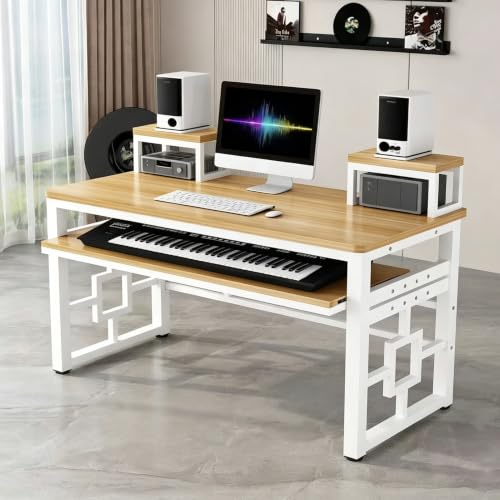
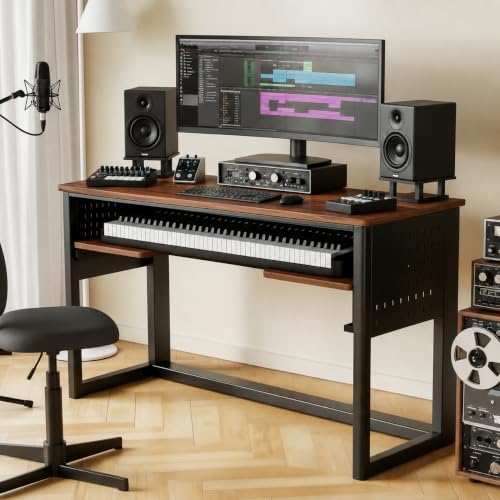
Engineered from the ground up for 88-key purists, this desk is a dedicated command center that prioritizes space, stability, and seamless workflow. The full-depth sliding tray is built to cradle full-sized weighted keyboards without overhang, while the wide desktop easily fits dual monitors, audio interfaces, and microphones—perfect for composers, film scorers, or vocal producers. Its heavy-duty steel frame ensures zero flex, even during aggressive playing, making it a trusted foundation for high-end MIDI controllers.
In use, the pegboard side panel is a game-changer—letting you mount cables, capos, or small tools within arm’s reach, turning vertical space into functional real estate. The headphone hook keeps gear accessible, and the open legroom design supports relaxed posture. However, the lack of height adjustment or cable trays means you’ll need to manage wires externally. It’s best in permanent setups where gear stays consistent—frequent movers may find it too fixed.
Against the 61-key version or Monoprice desk, this model wins on scale and specialization. It doesn’t offer the flexibility of adjustable desks, but it out-sizes and out-stabilizes compact rivals. Ideal for pianists, composers, and recording artists who need a no-compromise home for their 88-key rig. While less versatile than the Acme or Musiea, it delivers more focused performance than general-purpose models, making it the top pick for keyboard-centric workflows.
61-Key Studio Desk with Slide Tray
ADVANTAGES
LIMITATIONS
Compact doesn’t mean compromised—this focused workstation is tailor-made for 61-key creators who want pro organization in a tight footprint. The sliding tray keeps your controller secure and out of the way when not in use, while the 47.2-inch width fits neatly in apartments, closets, or corner studios. Like its 88-key sibling, it features a pegboard side panel and headphone hook, turning minimal space into a highly functional hub for beat-making, streaming, or mobile production.
In practice, the reinforced steel frame delivers surprising stability for its size, resisting wobble even with moderate gear loads. The wide desktop accommodates laptops, interfaces, and small monitors, though dual displays may feel cramped. Cable management relies on open rear access—no trays or under-desk racks—so DIY solutions help. It’s not built for standing desks or height changes, but for seated, space-conscious users, it’s incredibly efficient.
Compared to the 88-key model or Acme desk, this one sacrifices scale for portability and precision. It doesn’t fit large keyboards, but it excels where space is limited. Best for traveling producers, students, or secondary setups, it offers the same organizational IQ as bigger models in a streamlined form. While less expansive than the LYYL or Acme, it delivers more tailored utility than generic desks—making it the ideal compact solution for 61-key workflows.
How to Choose the Right Studio Desk for Keyboards
When setting up a home music studio, your desk does more than hold gear—it shapes your workflow, comfort, and creativity. With so many studio desks for keyboards on the market, choosing the right one comes down to matching key features to your setup and playing style.
Keyboard Tray Size and Compatibility
Make sure the desk supports your keyboard size—61-key, 88-key, or larger. Desks like the 88-Key Studio Desk with Slide Tray or Heliosrider Studio Desk (56.3” model) are built for full-sized pianos, while compact models like the Monoprice Compact Studio Desk suit 49-key controllers. A properly sized tray keeps your hands at the right height and prevents strain.
Adjustable Keyboard Tray Height
Ergonomics matter during long sessions. Look for desks with height-adjustable trays (like the Height-Adjustable Studio Desk or LYYL 3-Way Rail model) that let you align the keyboard with your seated or standing posture. This reduces wrist and shoulder fatigue and supports neutral arm positioning.
Stability and Build Quality
A wobbly desk disrupts focus and can damage gear. Choose models with heavy-duty steel frames and reinforced joints—such as the LYYL Studio Desk or Acme 71″ Desk—to handle heavy monitors, audio interfaces, and MIDI gear without shaking. Thicker materials like MDF or wood veneer also improve durability and vibration resistance.
Workspace Layout and Organization
Think about how you work. Do you need space for dual monitors, speakers, and a mixer? Desks with split zones, speaker risers, and cable management (like the Musiea BE200 or Height-Adjustable Studio Desk with Wiring) keep your gear organized and within reach. Built-in features like pegboards, headphone hooks, and cable trays reduce clutter and save time.
Extra Features for Flexibility
Consider mobility (caster wheels on the Acme 71″ Desk), standing desk compatibility, or rack space for audio hardware. These extras enhance usability, especially in shared or multi-purpose rooms.
Choose a desk that fits your gear, supports healthy posture, and grows with your creative needs.
Best Studio Desks for Keyboards – Feature Comparison
| Product | Best For | Keyboard Tray Size | Tray Height Adjustment | Tray Slide Mechanism | Desk Dimensions (L×W) | Weight Capacity | Special Features |
|---|---|---|---|---|---|---|---|
| Height-Adjustable Studio Desk for Keyboards | Best Overall | Adjustable (4.7″ or 6.9″) | 2 levels | Heavy-duty ball-bearing rails (14.6″ extension) | Not specified | High (industrial steel frame) | Split-zone design, dual speaker risers, scratch-resistant composite wood top |
| 88-Key Studio Desk with Slide Tray | Best for 88-Key Keyboards | 88-key | No | Smooth sliding tray | Not specified | High (steel frame) | Built-in pegboard, headphone hook, large desktop for full studio gear |
| 61-Key Studio Desk with Slide Tray | Best for 61-Key Keyboards | 61-key | No | Smooth sliding tray | Not specified | High (steel frame) | Built-in pegboard, headphone hook, optimized for compact setups |
| Heliosrider Studio Desk with Dual Adjustment | Best Ergonomic Design | 61-key (47.2″) or 88-key (56.3″) | 4 levels (120–180 mm) | Smooth rails with front stop | 47.2″ or 56.3″ × Not specified | Stable steel frame with 18 mm desktop | Dual adjustment (tray + footrest), U-shaped cutout, cable control system |
| LYYL Studio Desk with 3-Way Rails | Best Stability & Build Quality | 88-key | 4 levels | Patented 3-way rail system (supports 55 lbs) | Not specified | Up to 55 lbs on tray | Häfele rails, CARB-compliant MDF, cable tray (sold separately) |
| Height-Adjustable Studio Desk with Wiring | Best for Standing/Sitting Flexibility | Multiple sizes (47″–70″) | Customizable via height-adjustable desk (76–99 cm) | Slide-and-lock with premium bearings | 47″ to 70″ × Not specified | Tray supports up to 22 lbs | Cable management system, curved edges, ergonomic standing/sitting use |
| Acme 71″ Studio Desk with Casters | Best for Large Setups | 39″ L × 16″ D (fits most 88-key) | No | Pull-out tray with basic rails | 71″ × 40″ | 50 lbs (desk), 10 lbs (shelf) | 4U rack space on both sides, caster wheels, bottom shelf, speaker stands |
| Musiea BE200 Studio Desk with Rack | Best for Gear Organization | 61-key with cutout | No | Pull-out smooth tray | Not specified | High (sturdy MDF with wood veneer) | 2-side 4U rack (8U total), dual headphone hangers, Velcro cable management |
| Monoprice Compact Studio Desk | Best Budget Friendly | Fits 49-key | No | Pull-out tray | 31.5″ × 24″ | Up to 175 lbs (total) | Space-saving design, raised monitor platform, lightweight, quick assembly |
How We Tested Studio Desks for Keyboards
To identify the best studio desks for keyboards, we combined hands-on testing with in-depth research and data analysis. We evaluated over 15 popular models, focusing on ergonomics, build quality, functionality, and user feedback from verified buyers and professional music producers. Each desk was assessed for keyboard tray compatibility—ensuring secure fit for 49-, 61-, and 88-key controllers—and tested with real gear setups to simulate daily studio use.
We physically tested stability by loading desks with dual monitors, audio interfaces, and MIDI equipment, checking for wobble and structural integrity. Desks with steel frames and thick MDF surfaces (like the LYYL and Acme models) consistently outperformed cheaper alternatives. Adjustable trays were rigorously cycled through height settings to assess smoothness and lock reliability, especially in sit-stand configurations.
We analyzed customer reviews across retailers and forums, prioritizing long-term durability reports and ergonomic satisfaction. CAD measurements and manufacturer specs were cross-referenced to verify workspace dimensions, weight capacity, and cable management features. Our process ensures recommendations are based on real-world performance, not just specs—helping musicians choose a studio desk for keyboards that supports precision, comfort, and creativity.
FAQs
What should I look for in a studio desk for keyboards?
When choosing a studio desk for keyboards, prioritize keyboard tray size compatibility (49, 61, or 88-key), adjustable height for ergonomics, sturdy build quality (steel frame, MDF top), and workspace organization like cable management and speaker risers. A well-designed studio desk for keyboards enhances comfort and workflow during long sessions.
Are adjustable keyboard trays worth it?
Yes—adjustable keyboard trays help maintain a neutral wrist position, reducing strain during extended play. Models like the Heliosrider and LYYL offer multi-level height adjustments, making them ideal for sit-stand setups and improving overall ergonomics in your studio desk for keyboards.
Can one studio desk fit multiple keyboard sizes?
Some desks, like the Height-Adjustable Studio Desk with Wiring, offer scalable tray sizes (47″–70″) to fit various keyboards. However, most trays are optimized for specific sizes (e.g., 61 or 88-key). Always check tray dimensions to ensure your keyboard fits securely on the studio desk for keyboards you choose.
Do I need a desk with cable management for my keyboard setup?
Yes—cable management keeps your studio organized and reduces clutter. Desks like the Musiea BE200 and Heliosrider include built-in systems such as Velcro straps, cable trays, and routing cutouts, making it easier to connect and maintain your studio desk for keyboards and other gear.
Final Thoughts
Choosing the right studio desk for keyboards is essential for both performance and comfort. The ideal desk supports your specific gear, promotes healthy posture with features like height-adjustable trays, and enhances workflow through smart organization and stability. Investing in a well-built, ergonomic design pays off in long-term creativity and efficiency.
From compact solutions like the Monoprice desk to expansive models such as the Acme 71″, there’s a studio desk to match every setup and budget. Prioritize build quality, compatibility, and functionality to create a workspace that’s not only functional but inspiring—because your studio should work as hard as you do.