You’ve seen them on bookshelves, those heavy little objects holding rows of books upright. But what exactly is a bookend, and why has this simple household item become a powerful metaphor across politics, storytelling, and everyday language? The definition of bookend goes far beyond its physical form. Originally a practical tool, it now symbolizes structure, closure, and duality in time, space, and narrative.
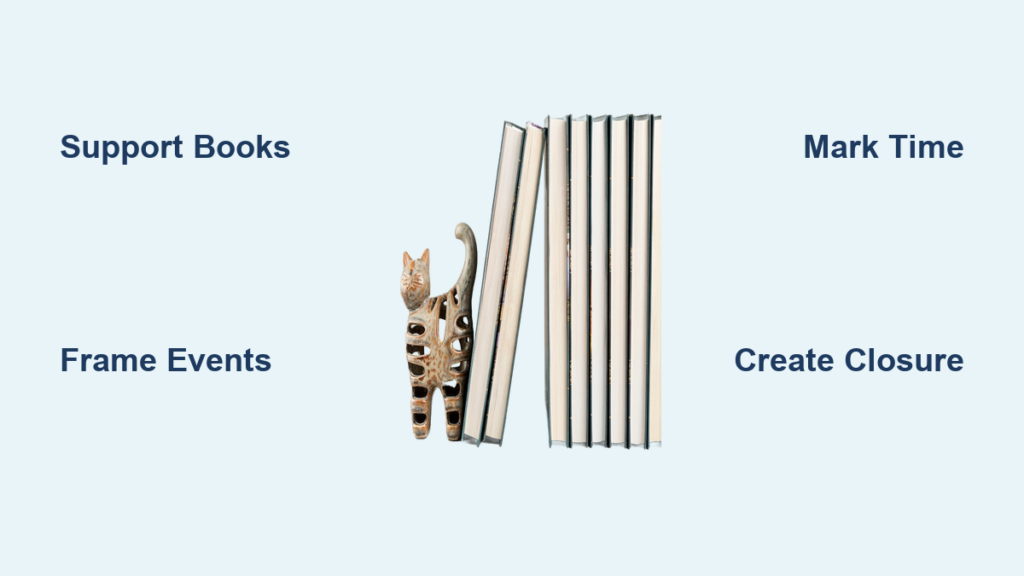
At its core, a bookend is a support placed at either end of a line of standing books to prevent them from toppling. Today, the term is just as likely to describe two events that mark the start and end of a historic era, or two powerful speeches that frame a political journey. This dual meaning, literal and figurative, makes “bookend” a uniquely flexible word in modern English. Whether you’re organizing your home library or analyzing a presidential address, understanding the full definition of bookend reveals how physical objects can evolve into rich linguistic tools.
Physical Bookend: Function and Design

A bookend’s job is simple: keep books standing. But achieving that requires smart design and the right materials. Without proper support, a row of books will lean and eventually collapse. That is where bookends come in, working in pairs to create stability through weight or mechanical grip.
Weight-Based vs. Clamping Designs
There are two main types of physical bookends: weight-based and clamping.
- Weight-Based Bookends rely on mass. Made from dense materials like marble, bronze, or solid wood, they resist the forward pressure of leaning books. The heavier the bookend, the more books it can support. These are common in homes and libraries where appearance matters.
- Clamping Bookends, based on William Stebbins Barnard’s 1877 patent, use a clever mechanism. A horizontal foot extends under the bottom of the book stack, while a vertical brace presses against the last book. As books are added, their weight clamps the foot down, locking the entire row in place.
Each type has strengths: weight-based models offer elegance and durability, while clamping types maximize function with minimal material.
Common Materials and Uses
Bookends are made from a variety of materials, chosen for both utility and style:
- Marble and Stone: Heavy and decorative, ideal for tall bookshelves.
- Bronze and Metal: Durable and often sculpted into artistic forms.
- Wood: Warm and versatile, fits rustic or modern interiors.
- Sheet Metal: Lightweight but effective, especially in clamping designs.
- Natural Formations: Large geodes or alabaster pieces serve as unique, conversation-starting bookends.
In institutional settings like libraries, aesthetics take a back seat. Simple metal brackets or unadorned L-shaped supports maintain order without drawing attention.
Improvised and Symbolic Uses
Not all bookends are manufactured for the purpose. An empty flowerpot, a brick, or even a heavy sculpture can serve as a makeshift bookend in a pinch. This flexibility highlights the concept’s core principle: any object that stabilizes the ends of a row can fulfill the role.
Architecturally, the idea appears in phrases like “two curved walls that bookend each room,” where the physical function mirrors spatial design by providing balance, protection, and visual framing.
Etymology and Language Evolution
The word “bookend” did not appear overnight. It emerged from a practical need and evolved into a dynamic verb and metaphor. Understanding its linguistic journey helps explain why it is so widely used today.
Origin and First Recorded Use
“Bookend” is a compound noun formed from “book” and “end.” Its first known use as a noun dates to 1907, though some sources place it between 1905 and 1910. This timing aligns with the rise of home libraries and mass-produced decorative objects in the early 20th century.
The verb form came later. “To bookend” was first recorded in 1956, marking a shift from physical object to active framing. This evolution reflects a growing cultural interest in structure, narrative, and symbolic closure.
Pronunciation and Rhyme
- Pronunciation: /ˈbʊkˌɛnd/ (BOOK-end), consistent across US and UK English.
- Rhymes: With words like amend, append, and bend, reinforcing its rhythmic, clipped sound.
The phonetic simplicity makes it easy to say and remember, contributing to its spread in spoken and written language.
Global Translations
Though the concept is universal, translations vary:
- Chinese (Simplified): 书立 (shū lì) or 书挡 (shū dǎng)
- Chinese (Traditional): 書立 or 書擋
These terms emphasize function (“book support” or “book stopper”) rather than metaphor, showing how cultural context shapes word usage.
Bookend as a Metaphor: Framing Time and Events
Today, “bookend” is more often used metaphorically than literally. In speeches, stories, and analysis, it describes two similar elements that mark the beginning and end of something larger. This framing creates cohesion, closure, and emotional resonance.
Defining a Time Period
One of the most common metaphorical uses is to mark the span of a historical era.
- “The Civil War and the civil rights movement bookend a century of racial struggle.”
- “This season was bookended by two major hurricanes.”
Here, the word does not just indicate time; it suggests significance. The events are not just first and last; they are defining moments that give shape to what lies between.
Career and Life Transitions
People use “bookend” to describe personal milestones:
- “Covering that song was a way to bookend my career.”
- “Graduating law school and arguing my first Supreme Court case bookended my training.”
These uses highlight a full-circle journey. The start and end points mirror each other, showing growth, completion, or reflection.
Weekly and Cyclic Patterns
In journalism and business, “bookend” often describes recurring patterns:
- “Stock declines bookended the week, wiping out midweek gains.”
- “The primaries bookended the election season perfectly.”
This usage emphasizes rhythm and symmetry in events, helping audiences grasp trends quickly.
Narrative and Rhetorical Bookending
In storytelling, “bookending” is a deliberate structural technique. Writers, filmmakers, and speakers use it to create unity, reinforce themes, and provide satisfying closure.
Framing a Story or Speech
A narrative may begin and end with the same scene, quote, or idea, bookended to create a loop.
- A film opens with a child looking at the stars and closes with the same person, now an astronaut, gazing back at Earth.
- An anthology is bookended by essays from the editor, framing the collection with context and reflection.
This technique signals to the audience that the story is complete. It is not a random sequence; it has a beginning, a middle, and an intentional end.
Political and Thematic Closure
President Obama famously used a 2013 State of the Union address to bookend a 2011 speech in Kansas. He was not repeating himself; he was completing a narrative arc about economic fairness.
- The first speech introduced the vision.
- The second confirmed progress and resolve.
Analysts noted this was thematic closure, like painting the second eye on a daruma doll. Only when both ends are present is the image whole. This rhetorical power makes “bookending” a favorite in political communication.
Cinematic and Literary Examples
- All the President’s Men (1976) is seen as bookending the era of heroic investigative journalism, its release coinciding with both the fall of Nixon and the rise of media skepticism.
- TV episodes often include “bookend” segments, short scenes before and after the main content, that set tone and provide reflection.
These uses turn time into a shaped experience, not just a timeline.
Spatial and Geographic Bookending
Beyond time and narrative, “bookend” describes physical positioning when two places or structures frame a central area.
Urban and Architectural Layouts
- “The mall is bookended by a bank and a supermarket.”
- “Two affluent neighborhoods bookend the downtown ghetto.”
In these cases, the term highlights contrast or balance. The framing locations define the character of what is in between, whether by wealth, function, or access.
Travel and Geography
Travelers use “bookend” to describe trip structure:
- “Our trip has Eastern bookends, starting in Ottawa and ending in Atlanta.”
- “The expedition was bookended by supply drops at both poles.”
This usage clarifies itinerary and emphasizes the journey’s scope.
Interior and Landscape Design
- “Horse-shaped bookends flank the poetry section.”
- “Two stone pillars bookend the garden path.”
Here, the word blends physical and aesthetic function. Just like real bookends on a shelf, these elements provide both support and visual balance.
Sports and Performance Bookends
In athletics, “bookend” describes players, events, or performances that anchor a team or competition.
Player Positioning
- “The team lost both bookend linebackers to injury.”
- “Our bookend pass rushers shut down the offensive edges.”
These players operate at opposite extremes but serve a unified role, protecting the center, applying pressure, or stabilizing the line.
Race and Relay Strategies
- “Klim and Thorpe bookended the relay with the fastest split times.”
- “The season was bookended by wins in the opening and championship games.”
When top performers appear at both ends of an event, they frame the team’s effort, often symbolizing consistency or dominance.
Draft and Season Arcs
- “The first and last picks bookended a dominant draft class.”
- “The season was bookended by filming in Los Angeles and New York.”
These uses emphasize symmetry and narrative completeness in competitive timelines.
Business and Communication Applications
Even in corporate settings, “bookend” has found a home, especially in branding, email strategy, and innovation cycles.
Email Structure and Branding
- “The bookends of your email are your address and signature block.”
These are the first and last things a recipient sees. A professional email address and a well-crafted signature reinforce credibility and brand identity. Weak bookends can undermine an otherwise strong message.
Innovation and Strategy
- “The launch of Project Alpha and its successor bookended a decade of disruption.”
- “The debate was bookended by two opposing policy statements.”
In strategy, “bookending” shows progression. It marks the start and end of a phase, making innovation feel intentional and complete.
Financial and Market Trends
- “The market was bookended by sharp declines on Monday and Friday.”
- “Q1 earnings bookended a volatile quarter.”
This phrasing helps investors spot patterns. When the same trend appears at both ends, it suggests instability or a recurring risk.
Grammar and Usage Rules
To use “bookend” correctly, it is essential to understand its grammatical forms and common constructions.
Noun: Singular vs. Plural
- Plural (“bookends”): Most common when referring to the physical pair or two framing elements. Example: “The marble bookends hold the encyclopedias.”
- Singular (“a bookend”): Used when one element completes a pair or serves as a metaphorical anchor. Example: “That speech was a bookend to his earlier vision.”
Verb: Transitive and Passive Use
- Transitive: Requires a direct object. Example: “Two crises bookended his presidency.”
- Passive: Common in formal writing. Example: “The era was bookended by two world wars.”
Prepositions and Collocations
- Bookended by: Indicates the framing elements. “The week was bookended by storms.”
- Bookend with: Indicates action taken to create framing. “Let’s bookend the meeting with quick check-ins.”
Common collocations include: bookend a career, bookend the year, bookend the discussion.
Key Differences: Bookend vs. Similar Terms
“Bookend” is often confused with “flank,” “bracket,” or “repeat.” But subtle differences matter.
Bookend vs. Flank
- Flank: Means to be on the side; can be one-sided. “Troops flanked the enemy.”
- Bookend: Implies both ends, creating symmetry. “Two towers bookend the bridge.”
Flanking is tactical; bookending is structural.
Bookend vs. Bracket
- Bracket: Can mean a range (“priced in the same bracket”) or a support in construction.
- Bookend: When used metaphorically, it emphasizes narrative closure and emotional resonance.
While you can “bracket a date,” saying “bookend a career” feels more complete and intentional.
Bookend vs. Repeat
- Repeat: Simply means to say or do again, with no structural implication.
- Bookend: Suggests framing, completion, and evolution.
Repeating a speech is redundancy. Bookending it gives it meaning.
Why Bookending Works: Psychology and Design
The power of “bookending” lies in human cognition. We are wired to seek patterns, symmetry, and closure.
The Psychology of Closure
The peak-end rule in psychology shows people remember experiences based on their peaks and endings. By placing strong elements at both start and end, “bookending” ensures a lasting impression.
This is why:
- Speeches open and close with powerful lines.
- Concerts start and end with hit songs.
- Marketing campaigns bookend launches with teaser and victory ads.
Design Principles in Practice
Whether physical or metaphorical, effective bookending follows design rules:
- Balance: Both ends should carry equal weight.
- Symmetry: Similar themes, tones, or structures.
- Contrast: Sometimes, opposites bookend to show transformation, such as poverty to wealth.
When these principles align, the result feels intentional, satisfying, and whole.
Frequently Asked Questions About Bookends
What Is the Simplest Definition of Bookend?
A bookend is a support placed at the end of a row of books to hold them upright. Metaphorically, it refers to two similar elements that frame a central event, period, or idea, providing structure and closure.
When Was the Word “Bookend” First Used?
The noun “bookend” was first recorded between 1905 and 1910, with 1907 being the most commonly cited date. The verb form “to bookend” appeared later, in 1956, marking its shift from a physical object to an active rhetorical device.
What Is the Difference Between “Bookend” and “Flank”?
“Flank” means to be on the side of something and can apply to one side only. “Bookend” specifically implies being on both ends, creating a symmetrical or balanced enclosure that frames a central subject.
How Are Bookends Used in Politics?
In politics, “bookending” describes two speeches or events that frame a leader’s term or vision. For example, President Obama used a 2013 State of the Union address to bookend a 2011 Kansas speech, completing a narrative arc about economic fairness.
What Materials Are Common Bookends Made From?
Common materials include marble, bronze, wood, sheet metal, and alabaster. Natural formations like large geodes are also used. In libraries, simple metal brackets are preferred for durability and cost-effectiveness.
Can “Bookend” Be Used as a Verb?
Yes. “To bookend” is a transitive verb meaning to frame something with similar elements at both ends. It is often used in passive constructions, such as “the era was bookended by two world wars.”
Key Takeaways for Understanding the Definition of Bookend
The definition of bookend has expanded far beyond its original purpose. Once just a shelf support, it now represents a fundamental way we structure time, stories, and space. From marble weights holding up books to speeches that frame a presidency, “bookend” captures the human desire for order, symmetry, and meaning.
Understanding this term, its history, uses, and nuances, helps you communicate more effectively. Whether writing a report, designing a presentation, or simply organizing your bookshelf, the concept of bookending adds clarity and intentionality. In a world full of chaos, the bookend reminds us that even the smallest supports can create stability, and the simplest frames can give shape to something much larger.